
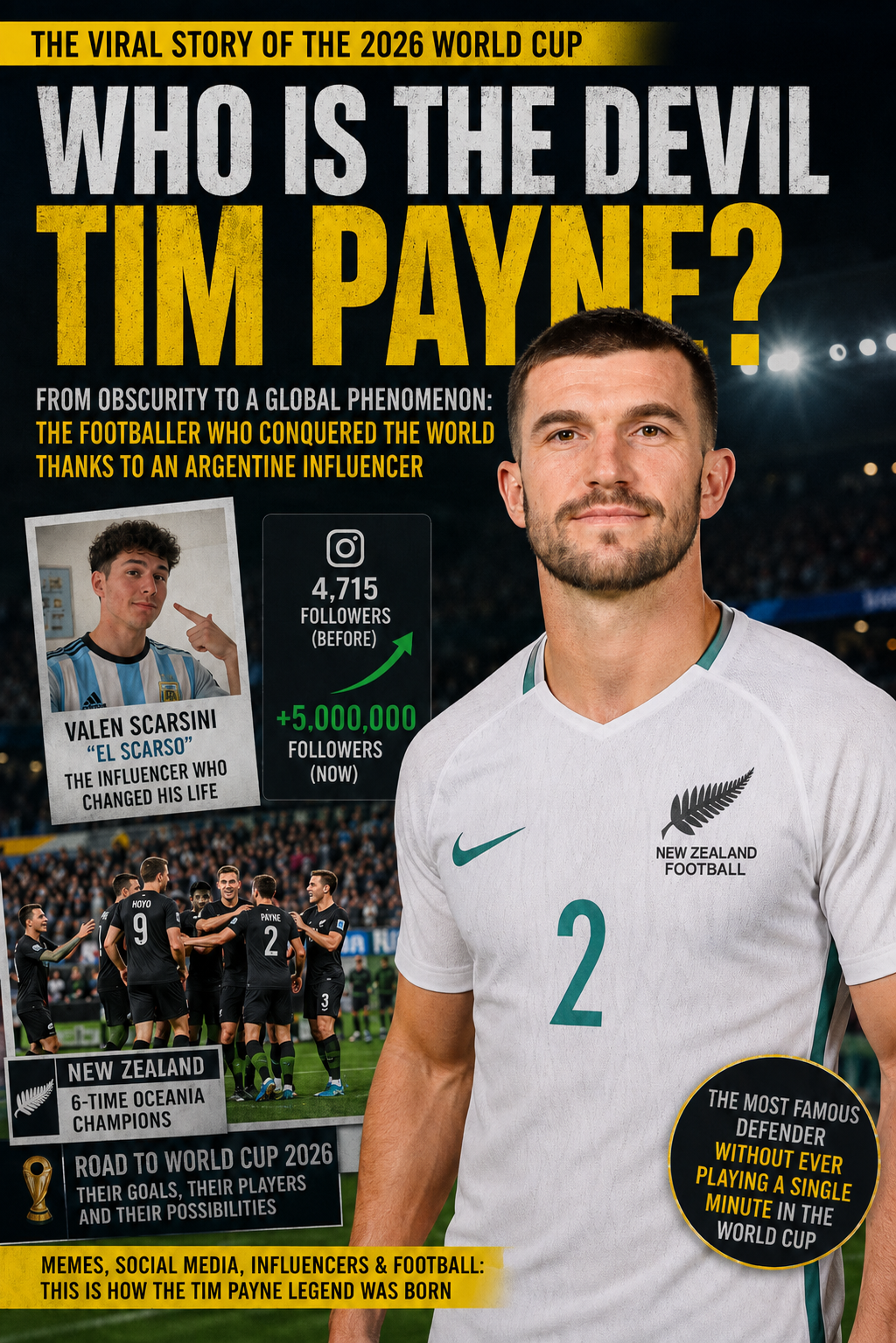
Just days before the start of the 2026 FIFA World Cup, world football has found an unexpected phenomenon. It is not Lionel Messi, Kylian Mbappé, Luis Díaz, or Jude Bellingham. Nor is it a young South American prodigy. The name millions of people suddenly started searching for online is Tim Payne.
Until late May, the New Zealand defender had fewer than 5,000 followers on Instagram. Two weeks later, he had surpassed 5 million and become one of the most talked-about personalities in world football. All thanks to a campaign launched by an Argentine influencer who decided to make the least-known player at the World Cup famous.
The Biography of Tim Payne
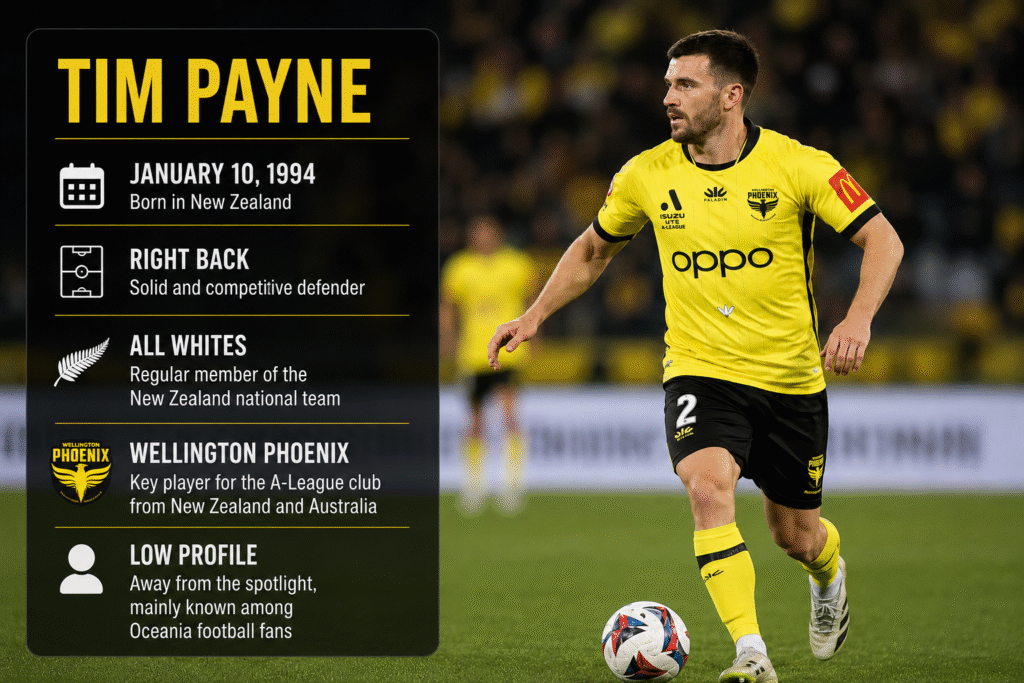
Tim Payne was born on January 10, 1994, in New Zealand. He plays as a right-back and spent most of his career maintaining a low profile, far from Europe’s major leagues and the spotlight of international media.
He established himself as a professional in Oceanian and Australian football, becoming a regular figure for Wellington Phoenix and New Zealand’s national team, known worldwide as the All Whites.
Unlike many World Cup stars, Payne was never a commercial icon or a player accustomed to magazine covers. His name was mainly recognized by football fans who closely followed the game in Oceania.
Until the internet arrived.
The Argentine Who Changed Payne’s Life
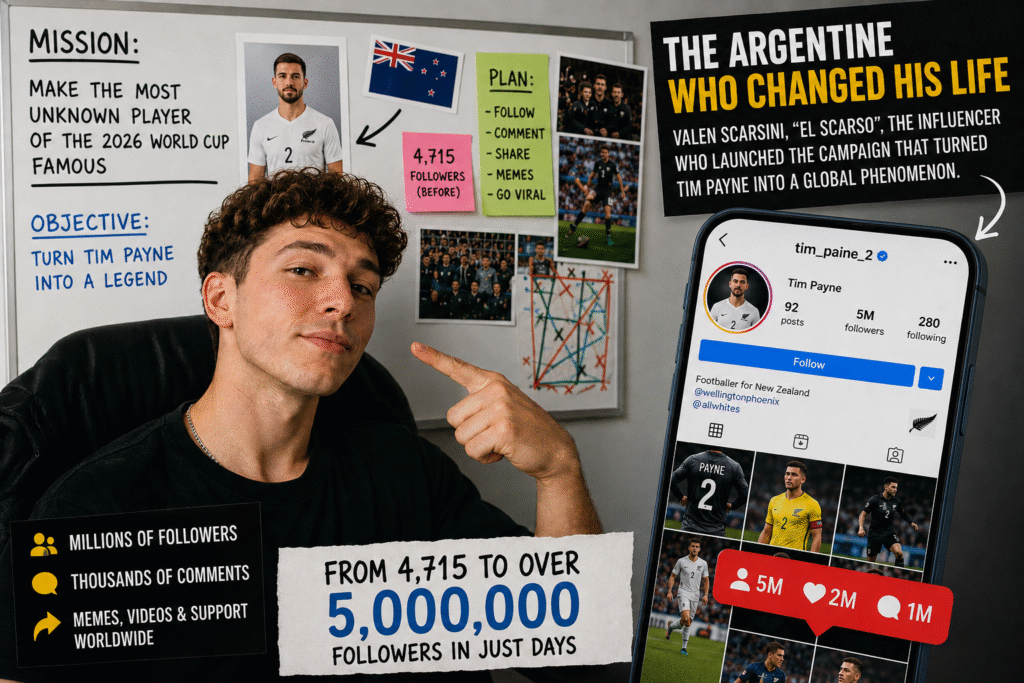
The man behind the phenomenon is Valen Scarsini, an Argentine content creator known online as “El Scarso.”
His idea was as simple as it was brilliant:
Find the least-known player among all the teams qualified for the 2026 World Cup and turn him into a global celebrity.
Scarsini reviewed every qualified national team, analyzed the popularity of their players, and eventually found Tim Payne, who had only around 4,700 Instagram followers. He then encouraged millions of followers on TikTok and Instagram to follow Payne, comment on his posts, and help turn him into an international sensation.
The response was immediate.
The Birth of a Viral Phenomenon
Within days, social media exploded.
Users began to:
- Follow Payne in massive numbers.
- Create memes about him.
- Invent humorous stories portraying him as a football legend.
- Share videos and edits.
- Search for his World Cup stickers and collectibles.
- Turn him into the subject of songs and chants.
- And even English-language vallenato songs.
What started as a digital experiment quickly became a global movement.
Payne went from fewer than 5,000 followers to more than 4 million in less than a week and later surpassed 5 million. He eventually achieved greater digital reach than some of New Zealand’s most recognizable sports stars.
The Meeting That Completed the Story
This story reached a new chapter when Tim Payne and Valen Scarsini finally met in the United States during New Zealand’s World Cup preparations.
The footballer personally thanked the Argentine influencer for transforming his life and giving him a level of international exposure he had never imagined possible. The two exchanged gifts, took photographs together, and shared a signed jersey in a moment that quickly went viral.
Payne publicly admitted that he was still processing everything that had happened and described the experience as “surreal.”
New Zealand’s Achievements
Although it often remains outside the global spotlight, New Zealand is currently the leading football power in Oceania.
OFC Nations Cup Titles
- 1973
- 1998
- 2002
- 2008
- 2016
- 2024
With six continental titles, the All Whites are the most successful national team in OFC history.
FIFA World Cup Appearances
- Spain 1982
- South Africa 2010
- United States, Mexico, and Canada 2026
To date, New Zealand has never advanced beyond the group stage and has never won a World Cup match. However, the team owns one of the most remarkable records in World Cup history.
The Record Nobody Can Take Away
At the 2010 FIFA World Cup in South Africa, New Zealand drew against Slovakia, Italy, and Paraguay.
The team was eliminated without winning a single game but finished the tournament unbeaten.
Even more remarkably, New Zealand was the only team in the entire tournament that did not lose a match — something that even eventual champions Spain could not achieve.
That statistic remains one of the greatest sources of pride in New Zealand football history.
New Zealand’s Prospects at the 2026 World Cup
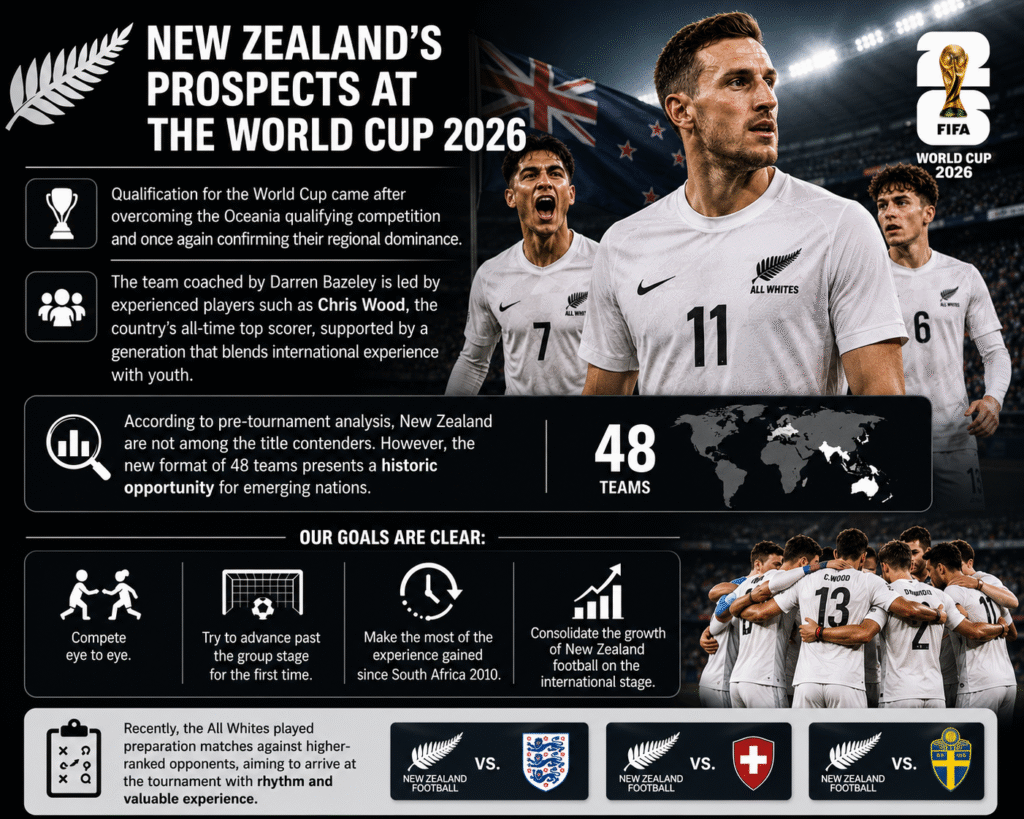
New Zealand secured qualification after winning the Oceania qualifiers and once again confirming its regional dominance.
The team coached by Darren Bazeley arrives led by experienced figures such as Chris Wood, the country’s all-time attacking reference, supported by a generation that combines international experience with youthful talent.
According to most pre-tournament analyses, New Zealand is not considered a contender for the title. However, the new 48-team World Cup format creates a historic opportunity for emerging nations.
Their objectives are clear:
- Compete on equal terms with stronger opponents.
- Reach the knockout stages for the first time.
- Build upon the experience gained since South Africa 2010.
- Continue the international growth of New Zealand football.
Recently, the All Whites have played preparation matches against higher-ranked national teams, seeking to arrive at the World Cup with rhythm, confidence, and valuable experience.
The Most Famous Player Without Playing a Minute
The 2026 World Cup has not officially begun yet, but Tim Payne is already the star of one of its most incredible stories.
It was not a multimillion-dollar transfer, a spectacular goal, or a football controversy that made him famous.
It was a community of millions of fans who decided to support the tournament’s most unknown player.
In an era dominated by algorithms, influencers, and social media, Tim Payne went from being a virtually anonymous defender from New Zealand to becoming one of the most recognizable names associated with the World Cup.
And it all started with an apparently absurd question from an Argentine content creator:
What would happen if the least famous player at the FIFA World Cup became a superstar?
What do you think?
Write to us at contacto@elnoticiario.com.co
WhatsApp: +57 305 308 5051