
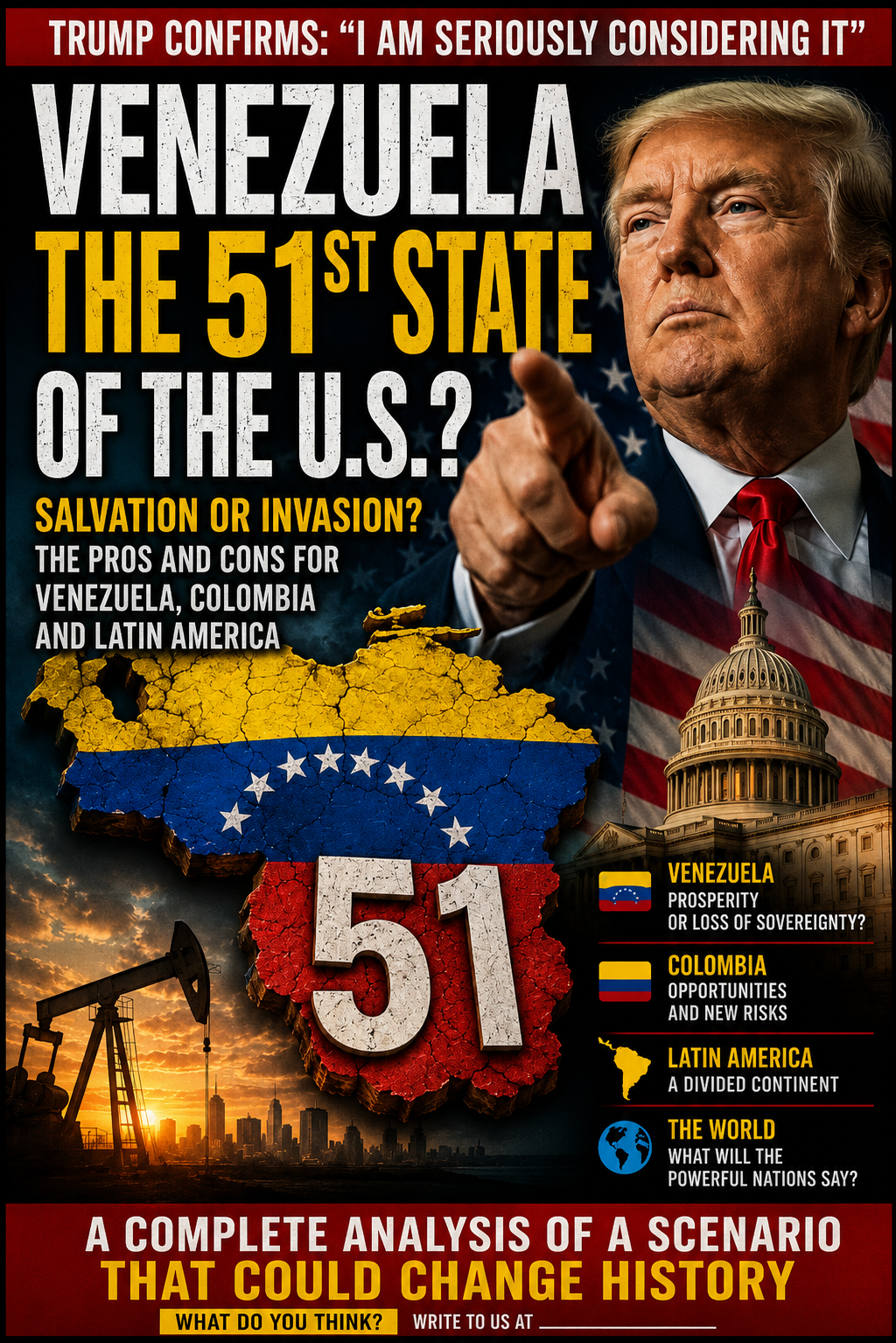
The idea sounded impossible just a few years ago. However, U.S. President Donald Trump has once again ignited a global geopolitical firestorm after reportedly saying he is “seriously considering” the possibility of turning Venezuela into the 51st state of the United States.
The statement comes amid an extraordinary scenario: the collapse of Nicolás Maduro’s regime, growing American political and economic influence inside Venezuela, and an intensifying global struggle for energy and strategic dominance in the Western Hemisphere.
Although many analysts consider the proposal legally unrealistic and politically explosive, the mere fact that the president of the world’s largest military power openly mentions it already carries enormous consequences for Latin America and the global balance of power.
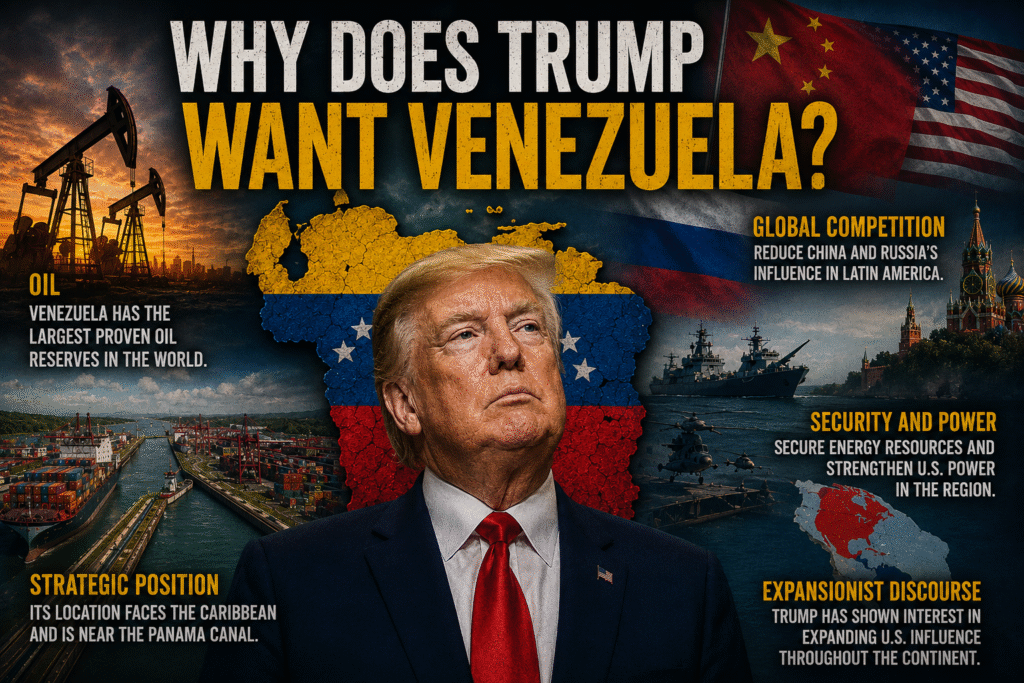
Why Does Trump Want Venezuela?
The answer can be summarized in four words: oil, geopolitics, China, and power.
Venezuela possesses one of the largest proven oil reserves in the world. Trump has repeatedly suggested that the country could become a key strategic asset for American energy security.
Additionally:
- The United States wants to reduce the influence of China and Russia in Latin America.
- Venezuela occupies a strategic position facing the Caribbean and near the Panama Canal.
- Washington fears that any political vacuum in Venezuela could be filled by rival global powers.
- Trump has promoted an expansionist discourse similar to comments he previously made regarding Canada and Greenland.
The Possible PROS for Venezuela
1. Massive Economic Investment
If Venezuela were placed under U.S. political control or formally integrated into the United States, it could receive:
- billions in investment,
- infrastructure reconstruction,
- oil industry recovery,
- technological modernization,
- monetary stability.
Many Venezuelan migrants dream of a stable, dollar-based economy.
2. The End of Decades of Crisis
Annexation could potentially mean:
- the disappearance of hyperinflation,
- stronger institutions,
- improved security,
- reduction of the power of armed groups and drug trafficking organizations.
For some sectors, it would represent the definitive end of the Chávez-Maduro era.
3. Direct Access to the American Market
Venezuela would gain privileged access to the world’s most powerful economy through:
- jobs,
- trade,
- investment,
- U.S. citizenship opportunities,
- federal programs.
The CONS for Venezuela
1. Total Loss of Sovereignty
For millions of Venezuelans, this would represent a historic humiliation.
The idea of a Latin American nation becoming part of the United States would revive memories of foreign intervention, colonialism, and dependency.
2. Possible Internal Conflict
Chavista sectors, military factions, and armed groups could rise up against any annexation attempt.
Experts warn that such a move could trigger:
- insurgencies,
- terrorism,
- regional violence,
- prolonged civil conflict.
3. Cultural and Political Clash
Transforming a country of more than 28 million people into an American state would create enormous challenges involving:
- language,
- legal systems,
- migration,
- political representation,
- social tensions.
What Would Happen to Colombia?
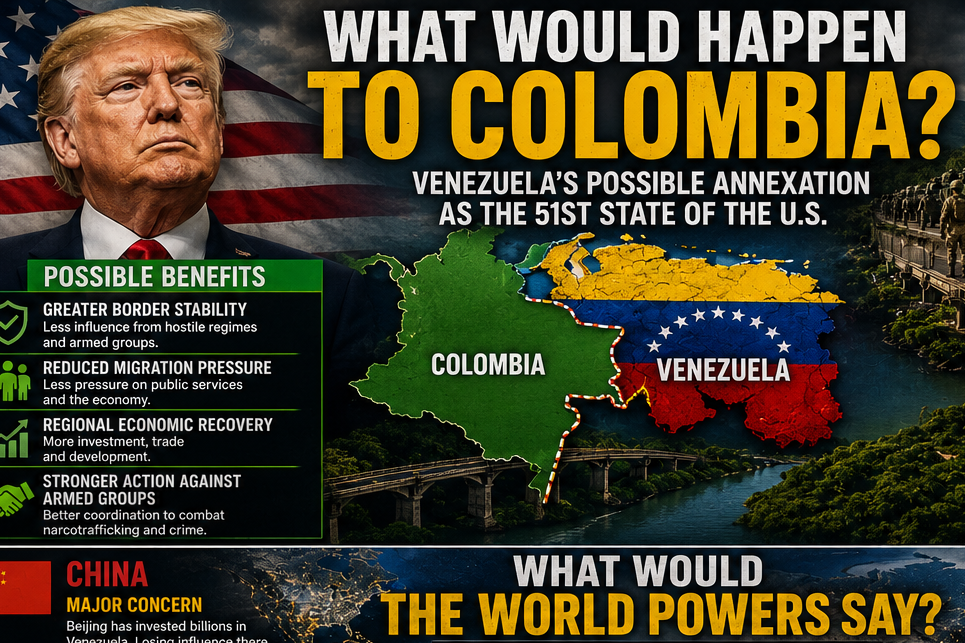
Colombia would become one of the countries most directly affected.
Possible Benefits
- Greater border stability.
- Reduced migration pressure.
- Regional economic recovery.
- Increased bilateral trade.
- Stronger action against armed groups operating across the border.
Possible Risks
1. Extreme Militarization of the Border
The United States could transform the Colombia–Venezuela border into a major military corridor.
2. Greater Geopolitical Pressure on Colombia
Bogotá could become trapped between competing global interests involving:
- Washington,
- Beijing,
- Moscow,
- regional powers.
3. Reaction from Illegal Armed Groups
The ELN, dissident factions, and drug trafficking networks could intensify violent activity if they feel threatened.
And What About Latin America?
The region would likely become deeply divided.
Countries That Might Support It
Governments allied with Washington could see the move as:
- a way to stabilize Venezuela,
- weaken authoritarianism,
- strengthen the Western bloc.
Countries That Would Reject It
Many governments would consider it:
- imperialism,
- an illegal annexation,
- a threat to Latin American sovereignty.
Organizations such as the Organization of American States and the United Nations would likely face a major diplomatic crisis.
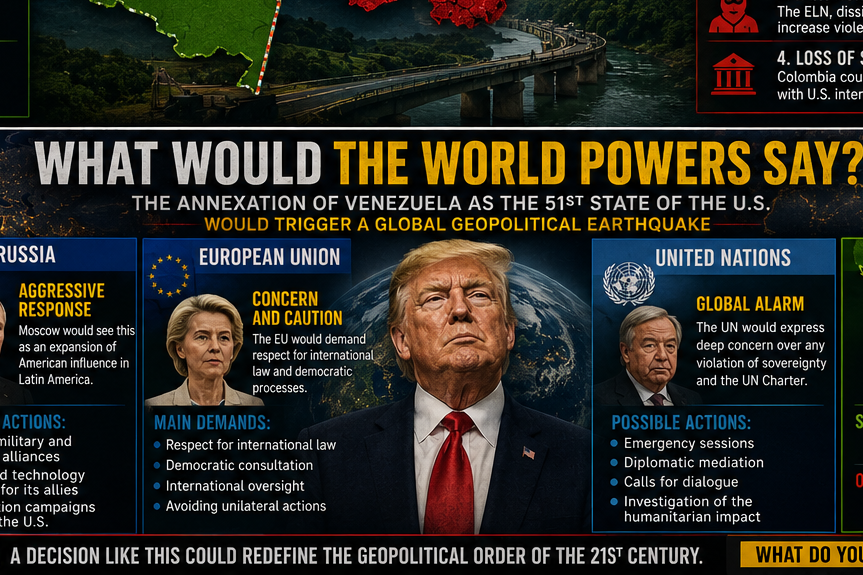
What Would the World Powers Say?
China
China would likely react with major concern.
Beijing has invested billions of dollars in Venezuela, and losing influence there would represent a major strategic setback.
Possible responses could include:
- economic sanctions,
- diplomatic pressure,
- military strengthening in other regions.
Russia
Russia would view the annexation as an aggressive expansion of American influence in Latin America.
Moscow could deepen military and political alliances with anti-American governments.
Europe
The European Union would likely demand:
- respect for international law,
- democratic consultation,
- international oversight.
Latin America
The continent would relive old historical fears:
- the Monroe Doctrine,
- American interventions,
- political dependence on Washington.
Is It Really Possible?
Legally, it would be extremely difficult.
The U.S. Constitution would require Congressional approval to admit a new state. Moreover, such an annexation would face massive obstacles involving:
- international law,
- regional opposition,
- Venezuelan resistance,
- enormous economic costs.
Historically, the United States has annexed sovereign territories such as Texas and Hawaii, but nothing similar has occurred in more than a century.
What Is Really at Stake?
Beyond whether it actually happens or not, Trump’s statement reveals something deeper:
The United States no longer views Latin America simply as a problematic neighbor, but as a strategic battlefield in the global struggle for energy, influence, and security.
And in that geopolitical chessboard, Venezuela has become a gigantic piece.
The question is no longer only whether Venezuela could become the “51st State.”
The real question is:
Are we entering a new era of American expansionism in Latin America?
What do you think?
Write to us at contacto@elnoticiario.com.co
WhatsApp 3053085051